
...

Journey to the Microcosmos
Every experiment has to start somewhere. This one began with a container full of dying microbes, and the five cute, pink ciliates called blepharisma that James, our master of microscopes, accidentally turned into a group of cannibals.
We’re starting this episode out with a question that we’re never going to have a good answer for: how many cells do animals have? How could we ever hope to count all those cells in each of those animals? And how could we even begin to assume that the amount of cells in one individual is going to be the same for all the other individuals?
Somewhere around 470 million years ago, something happened that shouldn’t have been particularly striking. An algae found its way onto land. This algae turned the lands of this earth green, altered the chemistry of our atmosphere, and created homes for future life. This algae would give rise to all of the land plants we know of today.
When you’re in the business of hunting for microbes, sometimes you have to send some weird emails. That’s why James, our master of microscopes, sat down one day to send his own strange request to the people at Coralaxy, a coral farm in Germany.
We’ve spent most of our journey through the microcosmos seeking out the organisms that are too small to see with just the human eye. The bacteria, the ciliates, the tardigrades. Part of what makes them so exciting to find is that they are so tiny. Every moment we spend with one of these organisms is a peek into something exceptional in our experience of the world, and it’s the result of how much work James, our master of microscopes, has put into hunting down as many microbes as he can.
James, our master of microscopes, recently received a package from a coral farm in Germany. We’ve explored some of the microscopic creatures and bristle worms that were living and thriving in those packages in previous videos. But today we’re here to focus on the main event: the corals.
We’re going to see a type of motion over and over again because it’s all over the microcosmos, found in and around many different types of organisms. And this kind of random motion may seem almost too trivial to discuss, but this motion that you see is a proof of something fundamental not just to life, but to existence itself. This movement… is proof… of atoms.
For an activity that mostly involves sitting and staring, microscopy is a surprisingly high stakes task. On the other side of the lens are drops full of potential, a multitude of worlds to unravel and examine. But they’re also fragile worlds, easy to fracture and lose with just a tiny slip of the hand. The stakes only get higher when you’re dealing with an organism so rare that it’s only been reported a few times since it was first discovered in 1901.
You’ve heard those worm horror stories, right? Stories of painful stomach cramps or diarrhea or nausea that eventually turns out to be caused by some worms that have taken up residence in someone’s intestines. It’s so terrifying and wild to think of something so much smaller than us causing so much havoc. But, what if worms had to worry about their own guts being taken over by a parasite?
This Loxodes magnus is large, so large that it was able to eat a rotifer, those funny animals we often see getting bullied by their single-celled neighbors. Except, that rotifer is moving. It’s alive, twisting and turning inside of the food vacuole it’s been stuffed into, and starting to fight back.
At first glance, they seem a bit more like plants or a series of flowers with thin, elegant petals. But no, they are indeed an animal. One that has the dubious honor of being defined largely by its anus.
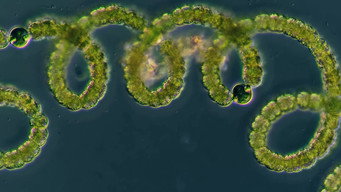
James, our master of microscopes, is not a farmer. He is, to put it simply, fascinated by microbes. And that may lead him to strange places and cause him to grow tanks full of weird things. But he is not a farmer.
The theme of today's episode is pretty simple: things we never thought we’d be showing you, but here we are.
It’s often said that one person’s trash is another person’s treasure. And surely there is no greater proof of that than the home of our master of microscopes, James. All along the windowsills and bookshelves are jars and tanks full of samples gathered from ponds, lakes, and oceans. And even his cabinets and drawers and bathroom hold stockpiles of what he’s found. There is just one problem though... the snails.
From our vantage point, as relatively large organisms, it can be easy to overlook the microcosmos, because it’s simply too small to see. It floats in front of our eyes at all times, and yet we cannot make out details until we turn to other tools.
Tardigrades have been through a lot. They’ve been sent to the moon. They’ve had the moisture sapped out of them. At times, they’ve been in extreme heat. And at other times, they’ve had to contend with extreme cold. Well, today, we’ve got a new one for you. A harrowing journey for these tardigrades that have taken them through, what we assume, must be the worst thing that tardigrades have yet been subjected to. These poor, enduring tardigrades got stuck in postal security.
The ciliates we’re going to talk about today are kind of…frustrating. At this point in our journey, we’ve gotten used to the fact that the microcosmos is an indecipherable mess at times, filled with organisms that look like each other, and who have familial relationships that seem obvious but then turn out to be a figment of our own limited imaginations. And these ciliates are yet another entry in the long-standing saga of ever-changing taxonomies that define our understanding of microbial species. The plot twist is inevitable.
The microcosmos might seem like a safe place from a surprise spider attack, but it would be misleading to pretend that it’s completely free of spider-like sightings. Because even at this small scale, you could find yourself subject to an ambush of the arachnid sort.
Usually on Journey to the Microcosmos, we spend our time looking at living organisms, things like insects, plants, and microbes that move and breathe and grow and die. But today, for these first few moments, these are the only living organisms we’ll be showing you, a montage of creatures whose bodies all share one very eye-catching trait: crystals.
Depending on your love of horror stories or your belief in the supernatural, it might be easy to convince you that lakes are full of ghosts. That as you plunge deeper into these lakes’ depths, you’ll come across translucent bodies that come alive when nighttime sets in; with its limbs all packed close to the head, wrenching open and closed like scissors that propel our spectral friend in jarring motions.